CEE Form Industrial Connectors (IEC 60309)
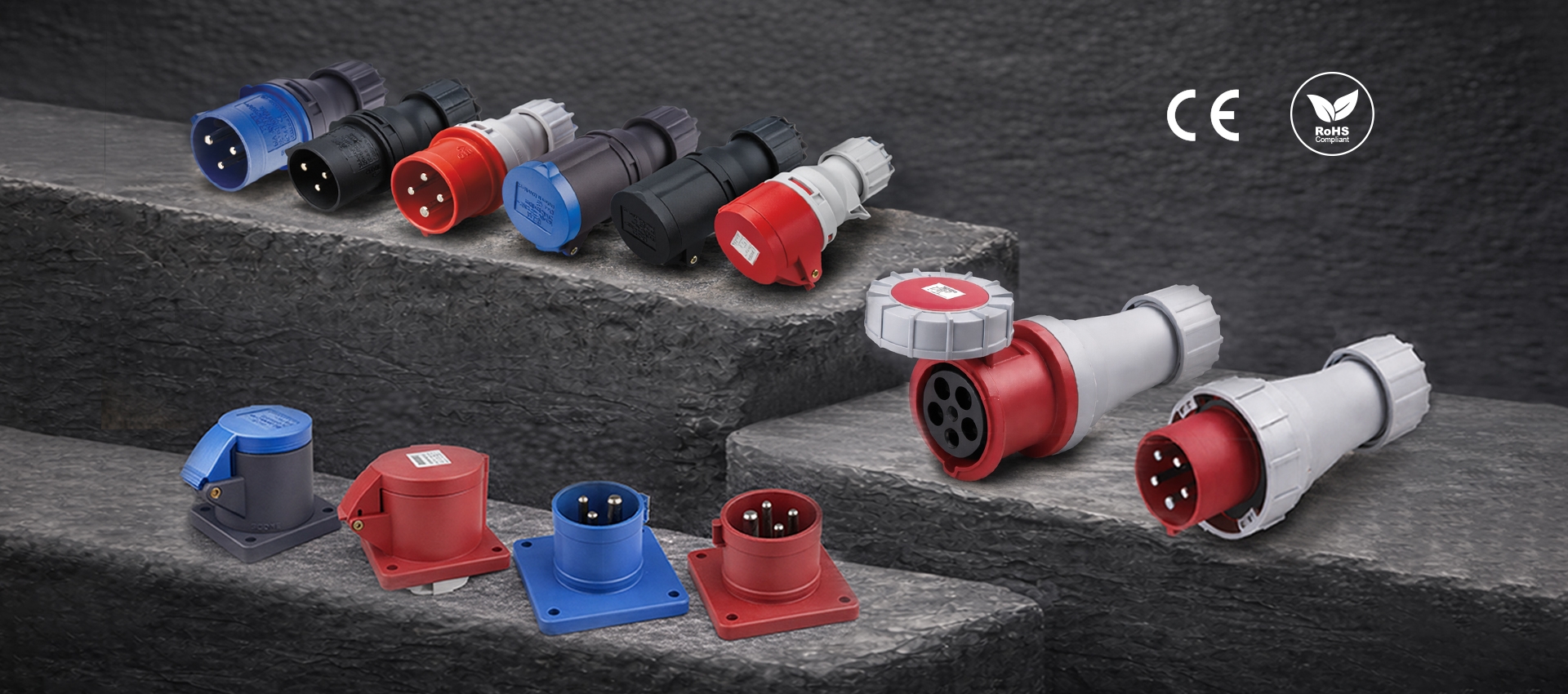
CEE form industrial connectors built to IEC (International Electrotechnical Commission) 60309-1 and 60309-2 standards for reliable temporary and permanent power distribution across industrial, commercial, and entertainment environments. Rated from 16A to 125A at 110V to 400V, the range spans single-phase and three-phase configurations in 3-pole (2P+E), 4-pole (3P+E), and 5-pole (3P+N+E) layouts. PA6 (Polyamide 6) Nylon flame-retardant housing with nickel-coated brass contacts. IP44 splash-proof protection on 16A and 32A models, IP67 watertight protection on 63A and 125A models. Color-coded by voltage per IEC 60309 convention: Blue for 230V, Red for 400V, Yellow for 110V. Earth-first safety engagement on all configurations. CE marked, RoHS and REACH compliant.
Request a Quote • Download Catalog (PDF)
Find Your Connector
Select your amperage and pole configuration to browse the full range of plugs, connectors, receptacles, and inlets in that combination.
3-Pole (2P+E) | 4-Pole (3P+E) | 5-Pole (3P+N+E) | |
|---|---|---|---|
— | |||
— | — | ||
Browse all |
Browse by Voltage
IEC 60309 assigns a specific housing color to each voltage class. The color is your first visual cue for identifying the correct connector.
Voltage | Color | Products | Application | Browse |
|---|---|---|---|---|
220-250V (230V) | Blue | 19 | Single-phase industrial, commercial, and portable equipment power | |
380-415V (400V) | Red | 16 | Three-phase heavy machinery, motor drives, and industrial distribution | |
100-130V (110V) | Yellow | 2 | Reduced-voltage construction safety circuits |
Browse by Form Factor
CEE form connectors come in four form factors. The names describe where the connector mounts and which side carries the pins (male) versus the sockets (female). Understanding the difference helps you specify the correct part for each position in your power distribution chain.
Form Factor | Products | What It Is and Where It Goes | Browse |
|---|---|---|---|
Plug | 10 | A plug mounts on the end of a cable and has male pins. It is the part you hold in your hand and push into a socket. Used on portable equipment power cords, extension leads, and cable assemblies. The plug connects into a receptacle (panel-mount socket) or a connector (inline female). | |
Connector | 11 | A connector mounts on the end of a cable and has female sockets. It is the receiving end of a cable-to-cable connection. Used on the output end of extension cables and portable distribution equipment. The connector receives a plug (inline male) or an inlet (panel male). | |
Receptacle | 9 | A receptacle mounts permanently on a panel or enclosure and has female sockets. It is the fixed socket that a plug connects into. Used on distribution boards, power boxes, wall panels, and equipment enclosures. Think of it as a panel-mounted outlet. | |
Inlet | 8 | An inlet mounts permanently on a panel or enclosure and has male pins. It is the fixed connection point where power enters a piece of equipment. Used on generator output panels, equipment enclosures, and any device that needs to receive power through its housing. A connector (inline female) plugs into the inlet. |
Simple rule: Inline connectors mount on cables. Panel connectors mount on equipment. Male has pins, female has sockets. A plug (inline male) mates with a receptacle (panel female). An inlet (panel male) mates with a connector (inline female).
IEC 60309 Color Code and Clock Position
IEC 60309 uses a color and clock position system to prevent cross-mating between incompatible voltage systems. The housing color identifies the voltage class, while the earth contact's clock position determines mechanical compatibility. A 6h plug will only fit a 6h socket. A 4h plug will only fit a 4h socket. This mechanical keying prevents cross-voltage connections.
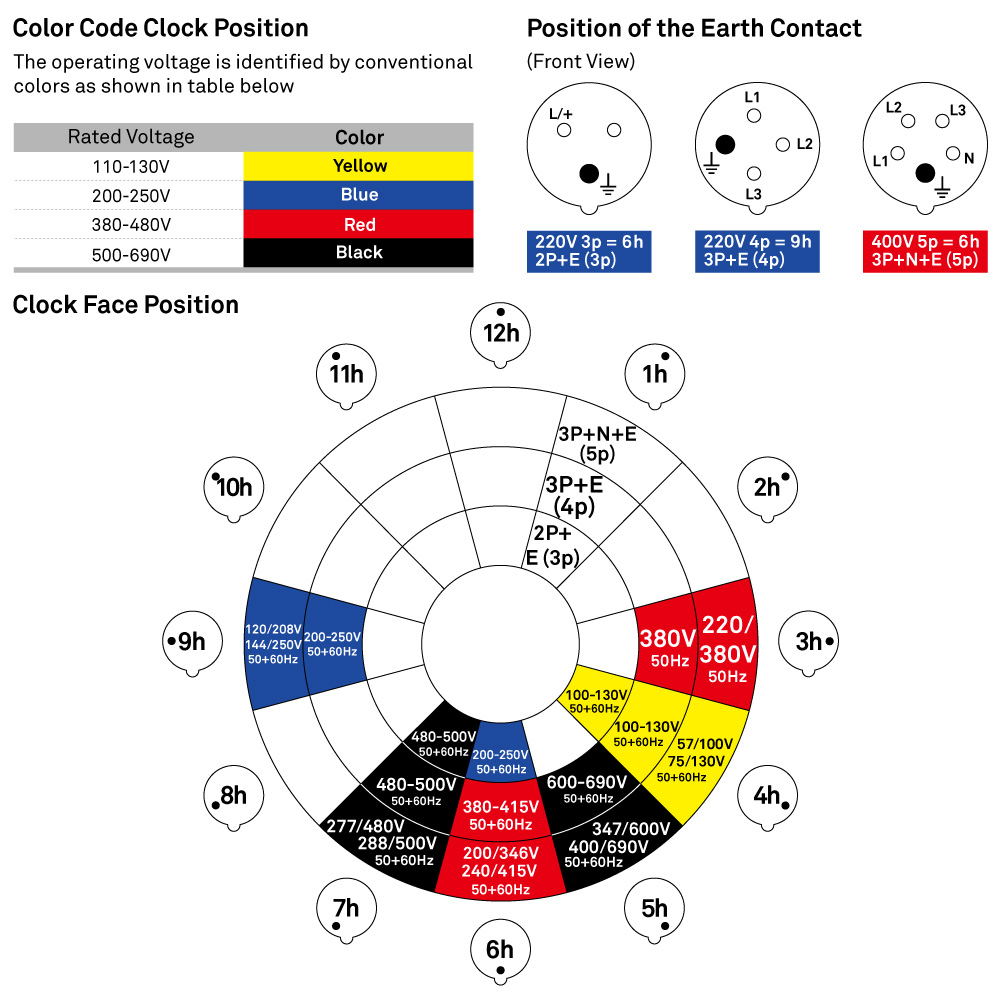
KUPO CEE Voltage and Clock Position Reference
In IEC 60309, the clock position is determined by the combination of voltage and pole count, not voltage alone. Connectors with the same clock position but different pole counts are mechanically incompatible, preventing accidental cross-connection.
Voltage | Poles | Color | Clock | Amperage Available |
|---|---|---|---|---|
110V | 3-Pole (2P+E) | Yellow | 4h | 16A |
230V | 3-Pole (2P+E) | Blue | 6h | 16A, 32A, 63A |
400V | 4-Pole (3P+E) | Red | 6h | 16A, 32A |
400V | 5-Pole (3P+N+E) | Red | 6h | 16A, 32A, 63A, 125A |
Why 6h appears twice: Both 230V 3-Pole and 400V 4/5-Pole use the 6h clock position, but they cannot be cross-connected. The different number of pins physically prevents a 3-Pole plug from entering a 4-Pole or 5-Pole receptacle, and vice versa.
Two Protection Tiers: IP44 and IP67
KUPO CEE form connectors are available in two IP (Ingress Protection) ratings. The amperage determines which tier applies.
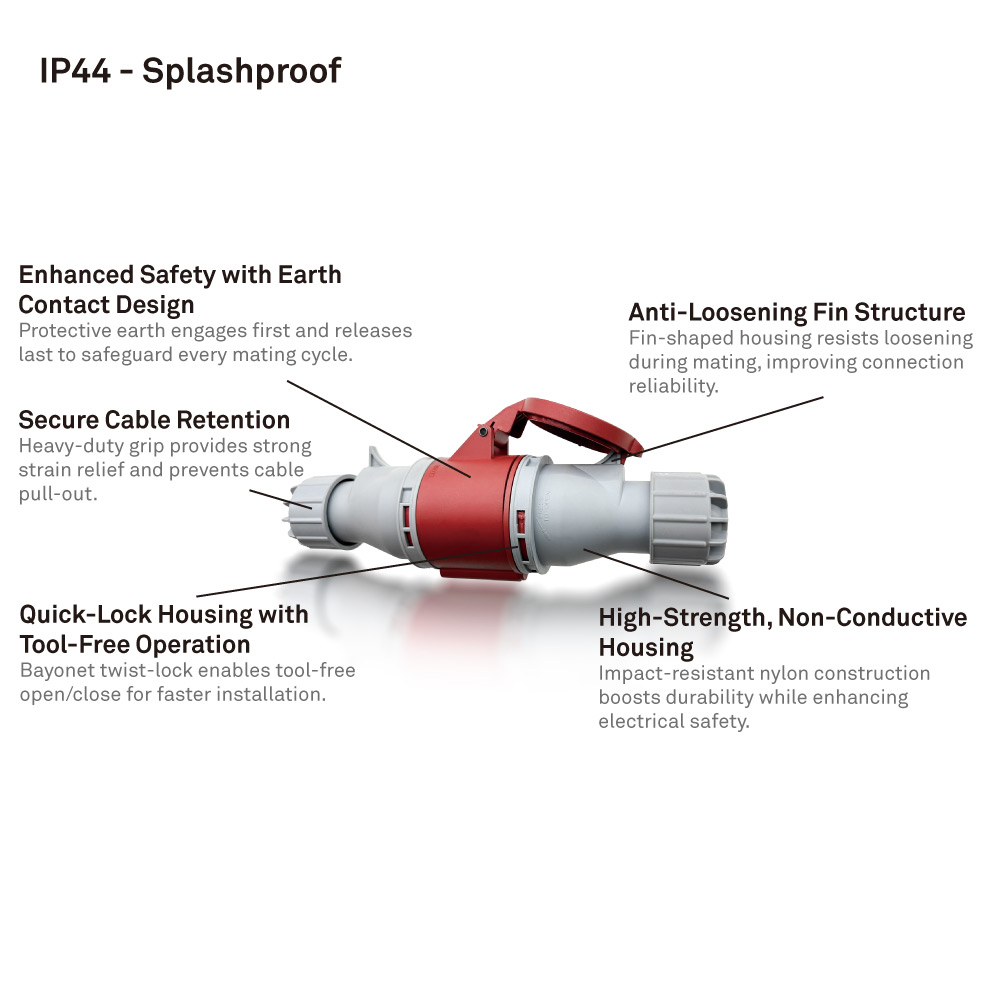
IP44 Splash-Proof (16A and 32A)
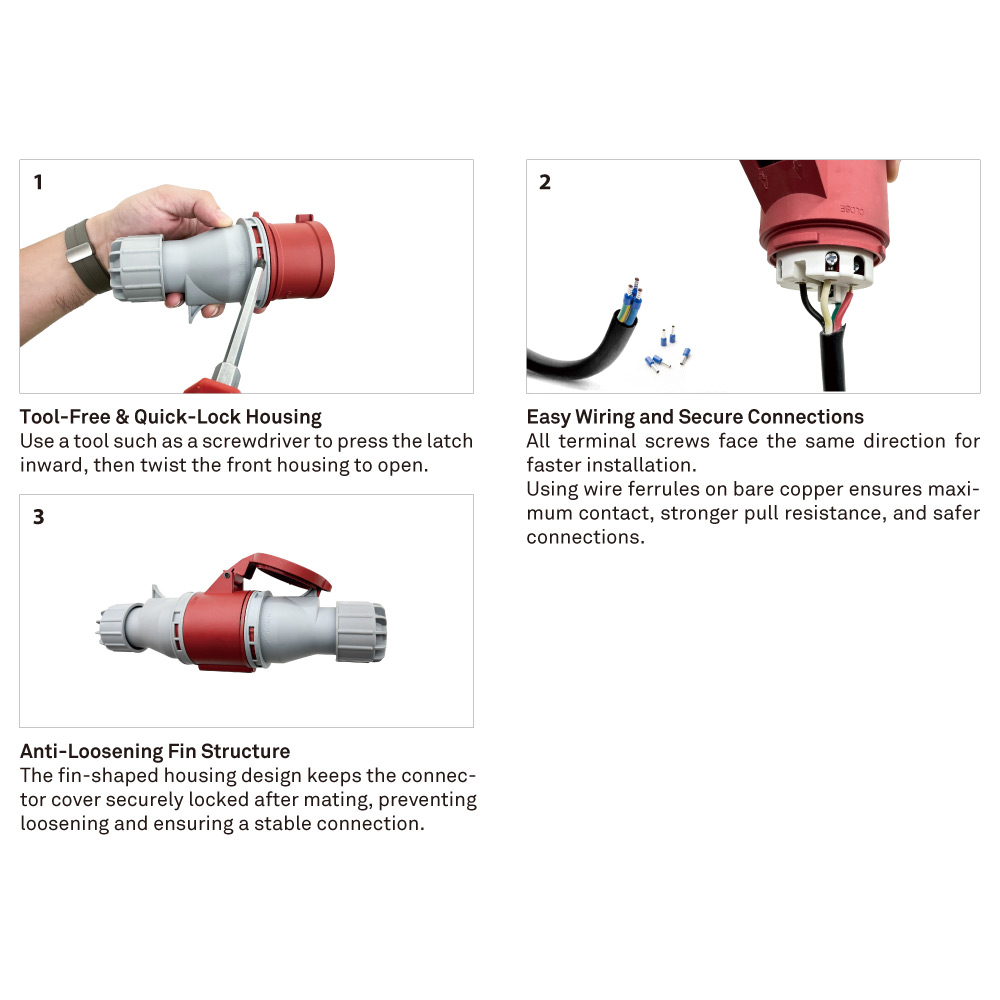
Bayonet twist-lock housing enables tool-free open/close access for faster installation. The anti-loosening fin structure keeps the connector cover securely locked after mating.
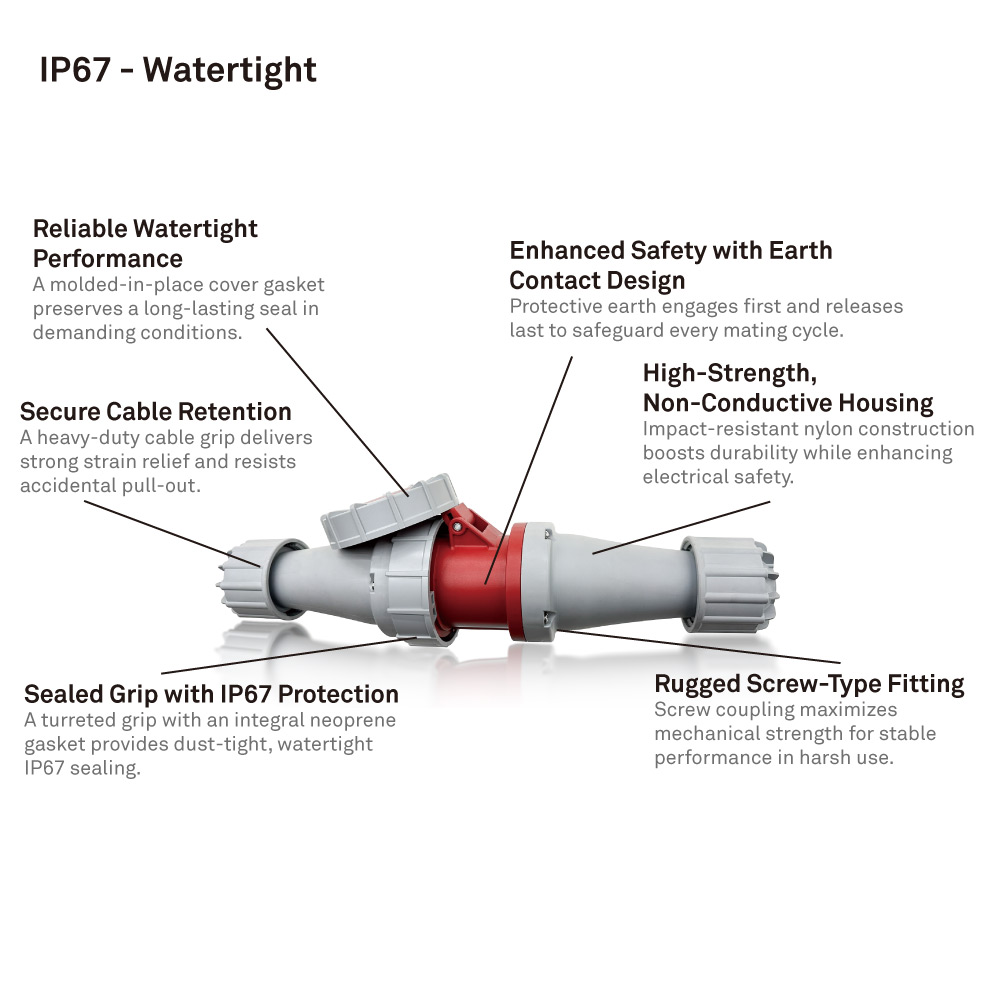
IP67 Watertight (63A and 125A)
Screw-type coupling and molded-in-place cover gasket provide dust-tight, watertight protection for harsh outdoor, wet, and dusty environments. Rated for temporary water immersion up to 1 meter for 30 minutes.
IP44 vs IP67 Comparison
Feature | IP44 (16A / 32A) | IP67 (63A / 125A) |
|---|---|---|
Protection | Splash-proof | Watertight (1m, 30 min) |
Coupling | Bayonet twist-lock | Screw-type |
Housing access | Tool-free | Screwdriver required |
Dust protection | Objects larger than 1mm | Complete dust-tight |
Best for | Indoor, sheltered outdoor | Harsh outdoor, wet, dusty |
Products | 25 | 12 |
Technical Specifications
Electrical
Current rating | 16A, 32A, 63A, 125A |
Voltage | 110V, 230V, 400V (per pole configuration and color code) |
Frequency | 50/60 Hz |
Standard | IEC 60309-1, IEC 60309-2 |
Mechanical and Environmental
IP rating | IP44 (16A, 32A), IP67 (63A, 125A) |
Operating temperature | -25 degrees Celsius to 40 degrees Celsius |
Housing material | PA6 (Polyamide 6) Nylon, flame retardant |
Contact material | Nickel-coated brass |
Safety feature | Earth-first engagement, earth-last disconnection |
Coupling (16A/32A) | Bayonet twist-lock with anti-loosening fin |
Coupling (63A/125A) | Screw-type with molded-in-place gasket |
Assembly and Installation
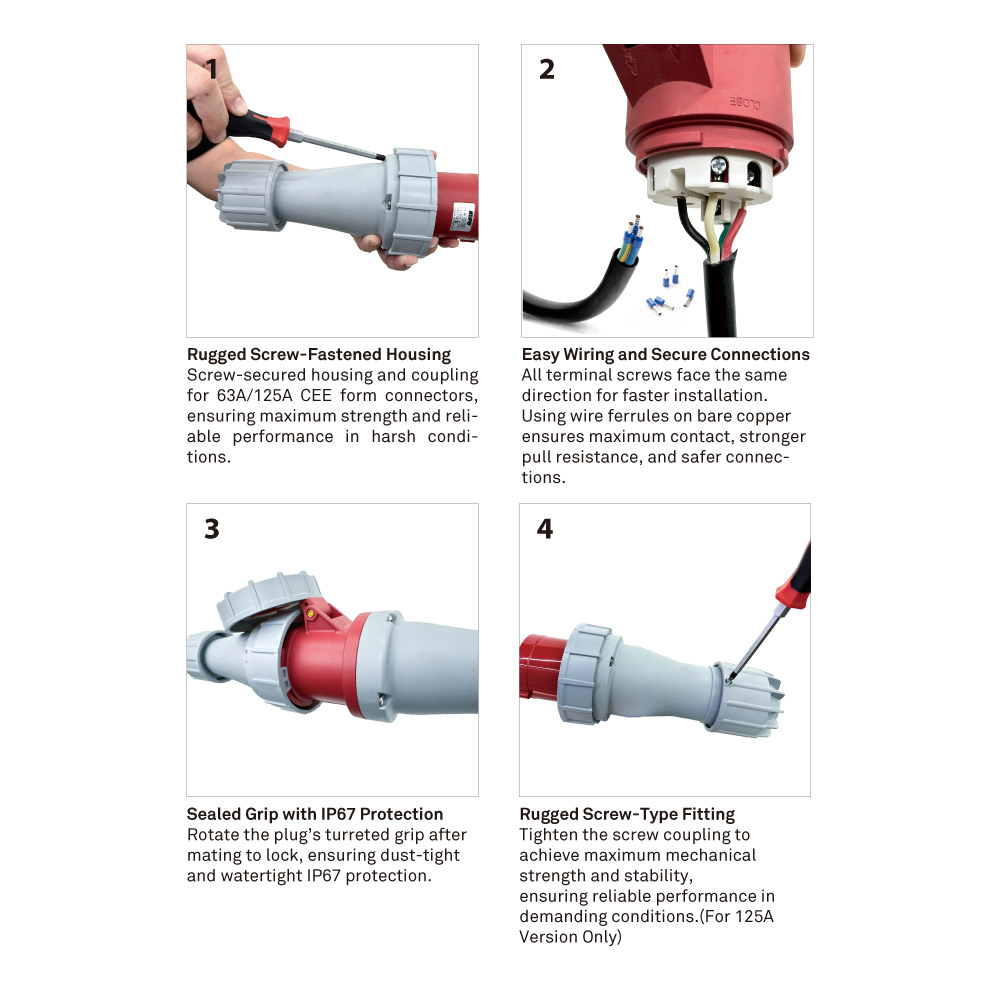
Always de-energize circuits before connecting or disconnecting connectors. All terminal screws face the same direction for faster, more intuitive wiring. Using wire ferrules on bare copper ensures maximum contact and safer connections.
IP44 Connector Assembly (16A and 32A)
IP44 connectors use a bayonet twist-lock housing that opens tool-free. Press the latch inward with a screwdriver, then twist the front housing to open.
IP67 Connector Assembly (63A and 125A)
IP67 connectors use screw-fastened housing for maximum mechanical strength. After wiring, rotate the turreted grip to lock for dust-tight and watertight IP67 protection. Step 4 (screw-type fitting for additional mechanical strength) applies to 125A models only.
SKU Decoder
KUPO CEE form connectors use the KHTN naming system. Every part number tells you the form factor, amperage, pole count, IP rating, and voltage variant at a glance. The encoding uses two formats depending on amperage.
16A and 32A (IP44): KHTN + [Form Factor] + [Amperage Tier] + [Pole Count] + [Suffix]
63A and 125A (IP67): KHTN + [Form Factor] + [Amperage Tier] + [Pole Count] + 1 + [Suffix]
The trailing 1 on 63A and 125A products indicates the IP67 (watertight) series. All 16A and 32A products are IP44 (splash-proof) and do not carry this marker.
Position | Code | Meaning |
|---|---|---|
Form Factor | 0 | Plug (Inline Male). Attaches to a cable, inserts into a receptacle or connector. |
2 | Connector (Inline Female). Attaches to a cable, receives a plug. | |
4 | Receptacle (Panel Mount Female). Fixed to a panel or enclosure, receives a plug. | |
6 | Inlet (Panel Mount Male). Fixed to a panel or enclosure, receives a connector. | |
Amperage Tier | 1 | 16A (IP44) |
2 | 32A (IP44) | |
3 | 63A (IP67) | |
4 | 125A (IP67) | |
Pole Count | 3 | 3-Pole (2P+E). Single-phase with earth. |
4 | 4-Pole (3P+E). Three-phase with earth. Available in 16A and 32A only. | |
5 | 5-Pole (3P+N+E). Three-phase with neutral and earth. | |
IP67 Marker | 1 | Present on 63A and 125A products only. Indicates IP67 watertight rating. |
Note on available combinations: 63A is available in 3-Pole and 5-Pole only (no 4-Pole). 125A is available in 5-Pole only. These reflect the standard IEC 60309 configurations for higher-amperage industrial applications.
Decode examples:
KHTN013 = Plug (0), 16A (1), 3-Pole (3). IP44. 230V Blue.
KHTN224 = Connector (2), 32A (2), 4-Pole (4). IP44. 400V Red.
KHTN4351 = Receptacle (4), 63A (3), 5-Pole (5), IP67 (1). 400V Red.
KHTN6451 = Inlet (6), 125A (4), 5-Pole (5), IP67 (1). 400V Red.
KHTN013-4 = Plug (0), 16A (1), 3-Pole (3). IP44. 110V Yellow, 4h clock.
KHTN213-BK = Connector (2), 16A (1), 3-Pole (3). IP44. 230V All-Black Entertainment.
Note on suffixes: -4 selects the 110V, 4h clock position variant (Yellow housing). -BK selects the all-black entertainment variant for stage and studio use. No suffix means the standard voltage for that pole configuration. Suffixes are available on 16A and 32A products only.
All-Black Entertainment Variant
For stage, studio, and live event production, KUPO offers all-black CEE form connectors with low-glare housing that blends into dark environments. Same 16A, 230V, 3-Pole (2P+E), IP44 specifications as the standard blue versions.
SKU | Product | Specs |
|---|---|---|
KHTN013-BK | All-Black Plug (Inline Male) | 16A, 3-Pole (2P+E), 230V, 6h, IP44 |
KHTN213-BK | All-Black Connector (Inline Female) | 16A, 3-Pole (2P+E), 230V, 6h, IP44 |
Browse All-Black Entertainment →
Certifications and Compliance
Certification | Detail |
|---|---|
IEC 60309 | Manufactured to IEC 60309-1 (general requirements) and IEC 60309-2 (dimensional interchangeability). Ensures global compatibility with other IEC 60309 certified equipment. |
CE | CE marked. Meets applicable European health, safety, and environmental requirements. |
RoHS | Compliant with RoHS (Restriction of Hazardous Substances) Directive. Both housing (PA6 Nylon) and contacts (Nickel-coated Brass) are RoHS certified. |
REACH | Compliant with REACH (Registration, Evaluation, Authorisation and Restriction of Chemicals). |
Downloads
Frequently Asked Questions
Can I disconnect a CEE connector while the circuit is live?
No. CEE form connectors are not rated for load-break disconnection. Pulling a CEE connector while current is flowing can create an electrical arc that damages the contacts, degrades the housing, and poses a serious risk of burns, shock, or fire. Always de-energize the circuit at the breaker or distribution panel, verify it is dead using a voltage tester, and only then disconnect. This applies to all CEE amperages (16A through 125A) and all IP ratings (IP44 and IP67).
What does the color of a CEE connector mean?
The housing color identifies the voltage class per the IEC 60309 standard. Blue indicates 220-250V (single-phase), Red indicates 380-415V (three-phase), and Yellow indicates 100-130V (reduced-voltage safety circuits). This color coding is an international standard, so a blue CEE connector from any manufacturer worldwide operates at the same voltage class. KUPO offers connectors in all three colors across the 16A to 125A range.
What is the clock position and why does it matter?
The clock position refers to where the earth (ground) contact sits on the connector face, described as an hour on a clock. For example, 6h means the earth contact is at the 6 o'clock position. IEC 60309 assigns specific clock positions to specific voltage and frequency combinations. A plug with a 4h earth position physically cannot insert into a socket with a 6h earth position, even if the amperage and pole count match. This mechanical keying is a safety feature that prevents accidental cross-voltage connections. All KUPO 230V and 400V connectors use the 6h position, while 110V connectors use the 4h position.
What is the difference between IP44 and IP67?
IP44 provides splash-proof protection: shielded against solid objects larger than 1mm and splashing water from any direction. IP44 connectors use a bayonet twist-lock housing that opens tool-free for fast wiring access. IP67 provides complete dust-tight protection and withstands temporary water immersion up to 1 meter for 30 minutes. IP67 connectors use screw-type coupling for maximum mechanical strength. In the KUPO CEE range, 16A and 32A connectors are IP44, while 63A and 125A connectors are IP67.
Can I use a 16A plug in a 32A socket?
No. IEC 60309 mandates different physical body sizes for each amperage rating. A 16A plug is physically smaller than a 32A socket and will not mate. This is an intentional safety feature: it prevents a cable or device rated for 16A from being connected to a 32A circuit, which could cause overheating or fire. Always match the amperage rating of the plug to the socket.
What does earth-first engagement mean?
The earth (ground) pin on a CEE form connector is longer than the live and neutral pins. During insertion, the earth contact makes connection before any live conductor touches. During removal, the earth contact breaks last. This means the equipment is always grounded before power is applied and remains grounded until power is fully disconnected. This earth-first, earth-last sequence is a fundamental safety feature of the IEC 60309 design and is present on all KUPO CEE form connectors.
What is the difference between a plug, connector, receptacle, and inlet?
These four terms describe where the connector mounts and whether it has pins (male) or sockets (female). A plug is an inline male that mounts on a cable and has pins. A connector is an inline female that mounts on a cable and has sockets. A receptacle is a panel-mount female (like a wall outlet) that receives a plug. An inlet is a panel-mount male that provides a fixed entry point for power into equipment. The mating pairs are: plug into receptacle, and connector onto inlet.
Are KUPO CEE connectors compatible with other brands of IEC 60309 connectors?
Yes. IEC 60309 is an international dimensional interchangeability standard, meaning all certified connectors of the same amperage, pole count, voltage, and clock position will mate regardless of manufacturer. KUPO CEE form connectors are manufactured to IEC 60309-1 and IEC 60309-2 and will intermate with other certified brands. Always verify that the amperage, pole count, and clock position match before mating connectors from different manufacturers.
What does 2P+E, 3P+E, and 3P+N+E mean?
2P+E means 2 poles plus earth (ground), which is a 3-pin connector used for single-phase circuits (one live, one neutral, one earth). 3P+E means 3 poles plus earth, which is a 4-pin connector for three-phase circuits without a neutral conductor (three live phases plus earth). 3P+N+E means 3 poles plus neutral plus earth, which is a 5-pin connector for three-phase circuits that also need a neutral conductor. Choose 2P+E for single-phase 110V or 230V, 3P+E for three-phase 400V where the load does not need neutral, and 3P+N+E for three-phase 400V where the load needs neutral (most common for general distribution).
What are the all-black entertainment connectors for?
The all-black variants (KHTN013-BK and KHTN213-BK) are designed specifically for stage, studio, and live event production. The low-glare black housing blends into dark environments where visible colored connectors might be distracting to audiences or on camera. They carry the same 16A, 230V, 3-Pole (2P+E), IP44 specifications as the standard blue versions and are fully compatible with all other 230V 6h CEE connectors.
How do I read a KUPO CEE part number?
Every KUPO CEE part number follows the KHTN naming system. The first digit after KHTN tells you the form factor: 0 = Plug, 2 = Connector, 4 = Receptacle, 6 = Inlet. The remaining digits indicate amperage and pole count. For example, KHTN023 is a Plug (0), 32A 3-Pole (23). Suffixes indicate voltage variants: -4 means 110V (4h clock position), -BK means all-black entertainment. No suffix means the standard voltage for that pole configuration. See the SKU Decoder section above for a complete guide with examples.
How do I choose between 3-Pole, 4-Pole, and 5-Pole?
It depends on the type of circuit you are connecting. 3-Pole (2P+E) is for single-phase power: one live, one neutral, one earth. This is the standard choice for lighting rigs, single-phase tools, and most portable equipment at 110V or 230V. 4-Pole (3P+E) is for three-phase power without a neutral conductor: three live phases plus earth. Use this for balanced three-phase motors and equipment that do not require a neutral reference. 5-Pole (3P+N+E) is for three-phase power with neutral: three live phases, neutral, and earth. This is the most versatile three-phase option and is required for distribution boards that feed both three-phase and single-phase loads from the same supply. When in doubt, 5-Pole is the safer choice because it provides the neutral conductor for maximum flexibility.
Can I use CEE connectors outdoors?
Yes, but the IP rating determines what conditions the connector can handle. IP44 connectors (16A and 32A) are splash-proof and suitable for outdoor use in dry to moderately wet conditions, such as covered stages, outdoor markets, and construction sites with overhead shelter. They should not be placed in standing water or exposed to sustained heavy rain without additional weatherproofing. IP67 connectors (63A and 125A) are dust-tight and waterproof to temporary submersion (1 meter for 30 minutes), making them suitable for fully exposed outdoor installations, wash-down environments, and temporary event power in all weather conditions.
What wire size do I need for each amperage rating?
The minimum conductor cross-section depends on the amperage rating and local electrical codes. General guidance based on IEC standards: 16A requires a minimum of 2.5 mm² (AWG 14). 32A requires a minimum of 6 mm² (AWG 10). 63A requires a minimum of 16 mm² (AWG 6). 125A requires a minimum of 50 mm² (AWG 1/0). Always consult local electrical codes and consider cable run length, ambient temperature, and installation method, as these factors may require a larger conductor than the minimum. The KUPO CEE connector spec sheets list the accepted conductor range for each product.
Do I need IP67 connectors for outdoor events?
Not necessarily. Many outdoor events use IP44-rated 16A and 32A connectors successfully, especially when cable runs are elevated, covered, or protected by weatherproof enclosures. IP44 handles splashing water and light rain. However, if your cables will be on the ground in standing water, exposed to heavy downpours without cover, or installed in environments where hosing or wash-down occurs, then IP67 is the appropriate choice. For permanent outdoor installations, IP67 is strongly recommended regardless of climate.
What is the maximum cable outer diameter for KUPO CEE connectors?
Each KUPO CEE connector has a cable gland that accepts a specific range of cable outer diameters. The accepted range varies by amperage. 16A connectors typically accept cables from 5 mm to 15 mm outer diameter. 32A connectors typically accept 8 mm to 21 mm. 63A and 125A connectors accept larger ranges suited to the heavier cables required at those amperages. Always check the specific product spec sheet for exact cable gland dimensions, as choosing a cable outside the gland range will prevent a proper seal and may compromise the IP rating.
Ready to specify CEE Form connectors?
Configuration help, bulk pricing, and technical documentation.
Request a Quote • Download Catalog (PDF)